

Chords and strumming
If your fingers feel too thick to fit on the A chord, there are several ways to finger it that need less room. Here are four, plus two guitar choices that give larger hands more space.
Most chord struggles fall into two camps: fingers that won’t stretch far enough, and fingers that feel too big to fit together. This lesson is about the second one. It usually shows up first on the A chord, because the common form puts three fingers side by side on the same fret.

Form #1: The Common A Chord
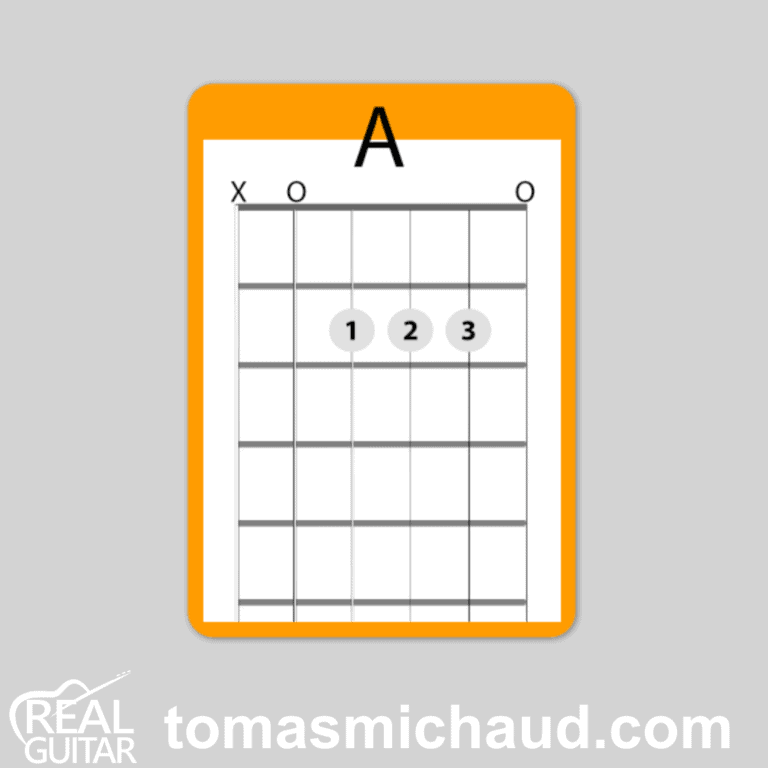
This is the form most people learn first: your first, second and third fingers all on the second fret, on the fourth, third and second strings.
In a chord chart, the three fingers look like they sit in a straight line, but in practice they shouldn’t. Angle them, almost 45 degrees. Your first finger sits quite a bit back from the fret, your second finger a little closer and your third finger right up next to the fret.

Angled like this, most people can fit their fingers in, even fairly thick ones. Check that every string still rings without buzzing.
Form #2: The Two-Finger Mini Barre
This is the form I use most. Your first finger covers both the fourth and third strings at the second fret, like a little partial barre, and your second finger plays the second string at the second fret.
To make it work, the knuckle of your first finger pops up in the air, and the top part of the finger presses both strings. Keep your second finger arched so it doesn’t touch the first string, which needs to ring open. It takes some practice, and once you have it, it’s a form you can get in and out of very quickly.
Form #3: The Pinky A Chord
This form uses your second, third and fourth fingers on the same three strings. Your pinky is smaller than your other fingers, so it takes a little less room. Angle the fingers the same way as in form #1, with the pinky right up next to the fret.
I don’t use this one often, and it isn’t my first suggestion for larger fingers. I use it when I need my first finger free to play something else.
Form #4: A Different Finger Order
I’ve seen students at my music school play A with the second finger on the fourth string, the first finger in the middle on the third string and the third finger on the second string. I don’t see a real advantage over form #1, and I can’t move in and out of it as quickly. But if it works for you, there’s nothing wrong with it.
I put these forms on a one-page cheat sheet with a few more notes. Download the A chord cheat sheet (PDF).
More Room for Larger Hands
If your hands are on the larger side, consider a classical (nylon-string) guitar. Its neck is wider, so the strings sit farther apart. It sounds different from a steel-string guitar, so whether it’s the right choice depends on the music you want to play and the sound you like.
If you want the steel-string sound, there’s a creative option: convert a 12-string guitar into a 6-string. A 12-string guitar has its strings in pairs. Remove the higher string from each pair, and you end up with a 6-string guitar with a wider neck and more space between the strings.
Give Your Fingers Time
Larger fingers are real, and the forms and guitars above can help. Over the years, though, I’ve also found that when students think a physical problem is keeping them from playing, it’s often more about underestimating what they can do with practice.
When you’re learning a new skill like guitar, almost everything feels awkward at first. It takes patience, practice and persistence, and the process builds more of each along the way.
For more ideas, see Difficulty Fingering Chords? Here’s Some Help. And which chord gives your fingers the most trouble? Let me know in the comments.
Want more lessons like this one? Try Real Guitar Success free for 14 days.
The advantage of the tech # 4 is you can use the third finger as the pivot finger when you want to change to D by anchoring the third finger then swich other fingers to D; when you want to change from A to E or E7, just slide the third finger to G#
I had that trouble at first with the A chord, then, I realized that I can make the same chord with two fingers instead of three cause my fingers are a little thick and cover three strings if I place them right. Probably not the best way or whatever but it works..
I often use two fingers for the A chord. Sounds good to me 🙂 – Tomas
The first position A chord is easy compared to barré C at the 3rd fret. The latter requires more strength, some hand stretching and less fret space is available to cram the other 3 fingers into the 5th fret.
Thanks for sharing Antonio. That’s true, especially on an acoustic or electric guitar. Most use the form of the C chord that has the partial bar in the 3rd finger for these.
Andres Segovia had “fat fingers”. He often talked about it.
Wow… I didn’t know that. Thanks Charles. – Tomas
When I began playing A chord I used form 1 but never sounded great, eventually I changed the fingers to form 4,perfect. Also much easier to change the fingers to D, and down to E.This is what I teach all beginners. Ger the guitar man in Galway
Thanks for sharing Ger. -Tomas
Here is my issue: I have a nice classical guitar I purchased 41 years ago while living in Mexico. It has been in a closet ever since. In order to reduce stress, I took it out, had it checked (still in great condition) and have been learning. My wife bought me a second guitar for Christmas. The nut is 1-3/4”. My Mexican guitar has a 2” nut. My hands are not large. They are XX large. I am struggling with it. I can return the new guitar (a beautiful Breedlove). But I hate to. Suggestions?