My Story
Hi, I’m Tomas

I’ve been playing and teaching guitar for more than 40 years, but I didn’t start out as one of those naturally gifted musicians who seemed to pick everything up easily.
I grew up in a family that didn’t really listen to music. Nobody played an instrument, and nobody put records on around the house.
I was the curious type, the kid who always wanted to know how things worked. By the age of twelve, I had assembled a chemistry lab in our basement, where I conducted experiments, made small homemade fireworks, and displayed considerably more curiosity than good judgment.
After a few accidents, I began to understand just how dangerous some of my experiments were. I also started wondering what I actually wanted to do with my life. I still loved chemistry, but I couldn’t picture myself spending my days working in somebody else’s corporate laboratory.
It Started With a Daydream
Around that time, I was sitting in class one day, drifting off while the teacher talked. In my mind, I saw myself in a small cabin in the woods, playing a little stringed instrument.
I imagined a mandolin, probably because of the mandolin solo in Rod Stewart’s “Maggie May.” It was also the only small, guitar-like instrument I knew existed.
I asked my mom for one for Christmas and, bless her heart, a mandolin appeared under the tree.
I began taking lessons from an Italian teacher who taught me Italian polkas. I practiced diligently and learned to play them reasonably well. I played that mandolin to death. I broke it at the neck. And when I tried playing with friends, nobody quite knew what to do with a mandolin, and my friends weren’t shy about telling me.
So I took the money I had saved from my paper route and bought an old, beat-up guitar.
I Struggled for Years
I learned a few open chords, some barre chords, and licks from popular songs. This went on for years. I could play bits and pieces of songs, but no matter how much I practiced, I never felt as though I was playing real music. I couldn’t play anything I would have wanted to perform for another person.
Worse, I had no idea how to improve.
When I finally decided to really learn to play, I figured the best approach was to find a guitarist who played the music I loved and take lessons. I took lessons from several different teachers and discovered something that would shape the rest of my life:
Just because someone is a good guitar player doesn’t mean they know how to teach.
Learning How to Learn
I thought college might provide the answer, so I studied classical guitar.
Classical music wasn’t the style I loved most, but the training gave me two things I badly needed. The first was solid technique. The second was a discovery that changed the direction of my life: difficult skills become much more manageable when they’re broken into the right steps and practiced in the right way.
That idea changed how I approached learning. Years later, it would become one of the foundations of how I teach.
It also sparked a lifelong curiosity about how people learn. The same curiosity that once had me experimenting in a basement chemistry lab was now focused on a different question:
How do you take something difficult and make it understandable, learnable, and even enjoyable?
Building a School
While I was in college, I began teaching at a local music school. When I graduated, the school came up for sale, and I decided to buy it.
I told myself it would be an interesting learning experiment. What I discovered instead was a passion for helping people learn.
Music had given me confidence and self-esteem at a time when I badly needed both. I wanted other people to experience that same kind of growth.
That little school eventually became Starland School of Music. Today, it serves 700 students, ranging in age from four to eighty-four, in the San Francisco Bay Area.
All these decades later, I still own the school. I’ve spent those years trying to build the kind of place where a nervous beginner, whether they’re seven or seventy, feels encouraged to learn, take risks, and grow.
Finding My Own Music
Let me be clear about something. I’m not a guitar prodigy. I’m simply someone who fell in love with the guitar and refused to give up.
Like many guitarists, I started with rock music: Led Zeppelin, Hendrix, and The Who. Young people today might call that “oldies,” although I strongly prefer “classic rock.”
I played in garage bands, in church, and eventually in clubs. I performed with my own groups and worked as a hired guitarist for other bands. Even after I bought Starland, I continued playing cover gigs at night.
I had fun and played with many talented people, but over time the nightclub lifestyle began to wear on me. Something was missing musically, too. I was always playing other people’s songs. I wasn’t expressing the music I heard inside myself.
Not long after that, I traveled to Spain as part of a language program. One day, I was riding a bus through the Spanish countryside, feeling low and missing home, when music began playing through the bus speakers. There was something rhythmic, soulful, and almost magical about it.
Using my rough Spanish, I asked the driver what was playing. He held up a cassette by the Gipsy Kings. I didn’t know it at the time, but that moment marked the beginning of a new chapter in my life.
When I returned home, I made a decision: I was going to create my own music.
It wasn’t easy. I had no idea where to begin, and it took years of lessons, books, DVDs, experiments, and playing with other musicians before I began to understand how to create the sound I was searching for.

Eventually, I recorded seven albums of original music and performed for many years, including appearances with respected guitarists such as Johannes Linstead, Rolando Morales, and John Gilliat.
I’m proud of what I accomplished, but getting there took much longer than it needed to.
What I wanted back then was actually quite simple. I wanted someone to show me what to learn, what order to learn it in, and how to practice it effectively. No one could give me that complete path, so I pieced it together myself, one teacher, one book, and one experiment at a time.
How Adults Learn
All that trial and error left me deeply curious about learning itself, particularly how adults learn.
I’ll admit, the motivation was partly personal. Learning hasn’t always come easily to me, and I wanted to understand what actually helps something stick.
That curiosity led me into teaching methods and the psychology of learning. I studied ideas such as deliberate practice, interleaving, spaced repetition, breaking difficult skills into smaller steps, and using tiny habits to develop consistency.
More importantly, I tested those ideas on myself.
Gradually, I worked them into guitar exercises, practice routines, lesson sequences, courses, and complete teaching systems.
I also learned that adults don’t practice in a vacuum.
They’re balancing work, family, responsibilities, limited time, and often a fair amount of frustration or self-doubt. Many worry that they’re too old, too slow, or simply not talented enough.
Knowing what to practice matters, but it’s only part of the solution. Practice also needs to feel manageable, purposeful, and emotionally sustainable.
Adults need to know where to focus. They need to make good use of the time they have. And they need enough small victories along the way to feel that their effort is leading somewhere.
That became my aim: to help adults understand what they’re doing, use their practice time wisely, and see enough progress to stay encouraged.
When the path is clear and improvement becomes visible, it’s much easier to keep going.
Bringing It All Together
Then I discovered a remarkable new technology called the internet.
I ended up learning far more about computers, cameras, lighting, websites, and filming than I had ever planned. At times, it felt suspiciously like being back in the basement chemistry lab, except with fewer explosions.
I began creating an online guitar program for adults. It took six years and three major revisions before I felt I had brought the pieces together properly.
That program became Real Guitar Success.
It wasn’t meant to be simply another collection of guitar lessons. It was my attempt to combine everything I had learned about music, practice, motivation, course design, and adult learning into one clear and supportive path.
Today, I teach adult students from around the world.
Why I Connect With Adult Learners

Every part of this story influences how I teach.
I remember what it feels like to practice for years and still not sound as though you’re playing real music. I remember being the outsider holding the wrong instrument. I remember searching for teachers, collecting fragments of information, and wondering why no one could simply show me a clear path.
So if you’ve ever felt frustrated, overwhelmed, or wondered why your hands and brain aren’t cooperating quite as quickly as you’d like, you’re in familiar territory here.
I believe adults can become very good guitar players. With a clear path, intelligent practice, patience, and enough small successes, you can make more progress than you may think.
That’s why I teach the way I wish someone had taught me: patiently, clearly, and step by step, without ever making you feel small because of where you’re starting, whether you’re picking up a guitar for the first time or coming back to one after years away.
Music can make life better at any age. It can build confidence, bring joy, awaken creativity, and remind you that growth is still possible.
I’ve built my life around that belief, and I’d be glad to help you find your own path. I’ll be both your guide and a fellow traveler, because honestly, I’m still learning every day, too.
Tomas
A Better Way to Learn Guitar as an Adult
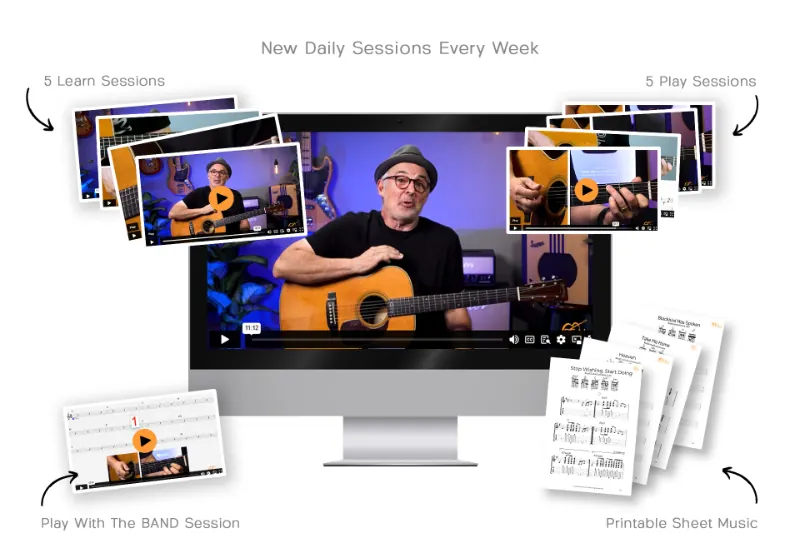
Real Guitar Success is my online membership for adult learners: a clear path, practice that fits your life, and patient encouragement that respects where you are. Try it free for 14 days and see how it feels.
“I have to say I’ve learned more from your intro 14 day trial than I have at my other two attempts.”James Dumas, Sandy, Utah