


Chords and strumming
Is the F chord keeping you from songs you want to play? The most popular song keys use it, so there’s no way around learning it. Here’s an easy version of the F chord that sounds good and needs no barre. If you can play a C major chord, you’re 80% of the way there already. Ready? Let’s do this!

How To Play the Easy F Chord
Four Fingers, No Barre

How to play it
- Index finger on the second string, first fret.
- Middle finger on the third string, second fret.
- Ring finger on the fifth string, third fret.
- Pinky on the fourth string, third fret.
- Strum the middle four strings. The low E and high E strings aren’t part of the chord.
To keep the two E strings quiet, I mute them with my fretting hand: the index finger touches the high E string lightly, and the ring finger leans against the low E. For the high E string you can also just strum so you don’t hit it. I do both.
Does the Easy F Chord Sound as Good?
You might be thinking, “That’s all fine, but will it really cut it? Will it sound anywhere near as good as a full F barre chord?” In short, yes. For proof, listen at 2:01 in the video, where I play both. There’s a slight difference, but when you’re strumming through a song I don’t think you’ll notice it.
A note for the curious: this easy F isn’t just a simplified barre chord, it’s a different voicing of the F chord. Musicians use different voicings of the same chord on purpose all the time.
Practicing the Easy F Chord
Being able to finger the easy F doesn’t help much until you can get to it smoothly and automatically. Here’s a very effective way to practice it, for two reasons. First, it uses two chords you’ll change between often in songs, so you’re practicing a movement you’ll really use. Second, it uses a method I teach inside Real Guitar Success called Common Chord Fingers.
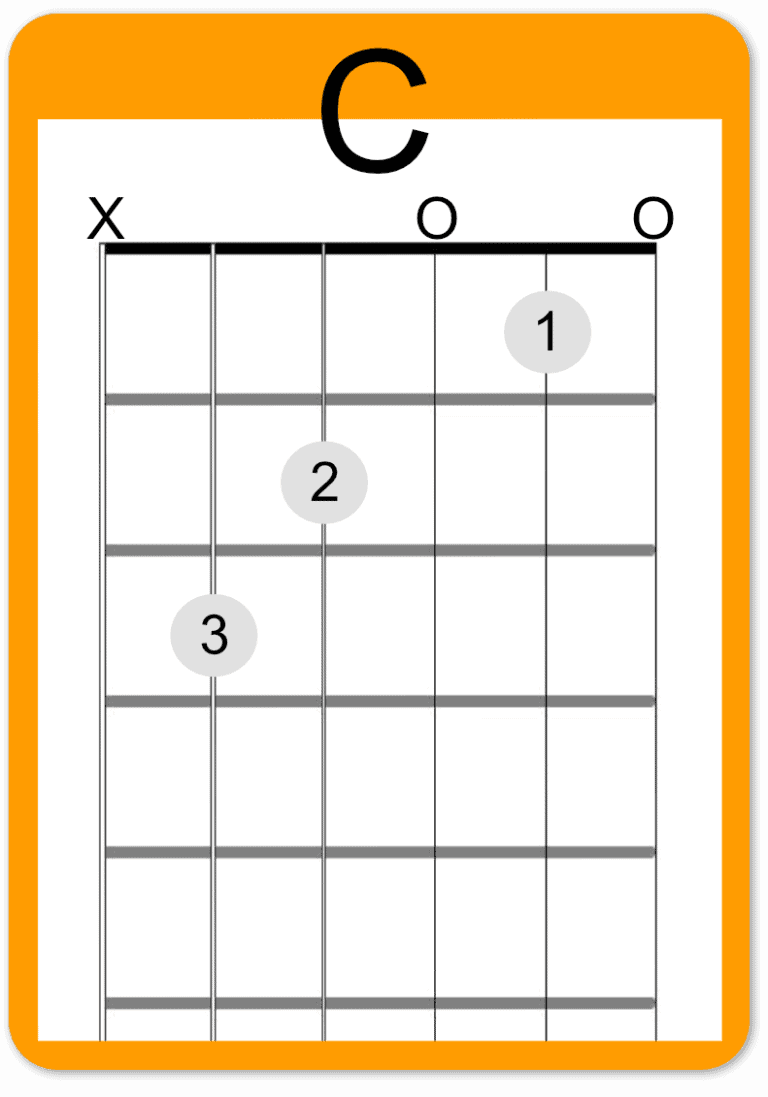
- Make a standard open C major chord (the left diagram).
- Move your middle finger up one string to the third string, still at the second fret, and put your pinky on the fourth string, third fret. That’s the easy F.
- Your index and middle fingers don’t leave their frets. These are the Common Chord Fingers. Now move back to the C chord the same way.
- Do this several times without strumming, just to get the feel of the movement.
- Now strum the C chord twice, change to the F and strum twice, keeping the Common Chord Fingers in place each time. Use a metronome at a slow speed and practice changing on time, without stopping or slowing down.
- When that’s comfortable, go to one strum per chord.
- Finally, raise the metronome speed little by little to build your changing speed.
Do this a little each day and you’ll have the easy F under your belt.
Final Thoughts About the Easy F Chord
One more thing. The easy F is useful, and it can stand in for any F barre chord, but there’s still real value in learning barre chords, mostly because you can play them up and down the neck. The F barre chord is a good stepping stone, because it teaches you how barre chords work. For a step-by-step path from a two-string partial barre to the full F barre chord, see F chord a problem? Not any more.
Here’s a quick way to grow the easy F into a partial barre: finger the easy F, then flatten your index finger so it covers both the second and first strings at the first fret. The step after that is the full barre chord, and that’s another video (or two, or three, or four).
Thank you for being here with me. If you haven’t already, subscribe to my YouTube channel and leave me a comment; I love hearing from you. And if you’re ready to take your playing further, Real Guitar Success has a whole course on barre chords. I’d love to see you there.
Want more lessons like this one? Try Real Guitar Success free for 14 days.
Thank you very very much TOMAS MICHAUD Sir. In the beginning stage of playing F chord, this style and shape will do a great help to me. God bless you and your family and your team.
You’re very welcome Dharmendra. Glad I could help. -Tomas
Very easy, thanks!
You’re welcome Jeanna.
Thanks for the great tutorials on the "F" and "G" chords! I've been struggling with these
for quite some time now. This a real break through for me.