

Beginner lessons
How you hold a pick makes a real difference to your strumming. Here’s how I hold it, which pick to start with and the arm motion that gives you a smooth strum.
In my years of teaching, two things give new students the most trouble: changing chords on time, and getting a smooth strum without the pick falling on the floor. This lesson is about the second one.

Do You Need a Pick?
You don’t have to use a pick. I sometimes suggest that new students strum straight down with their thumb at first, so they can focus on their chord fingers without also managing a pick. On my nylon-string guitar, I strum with my thumb and fingers.
Still, it’s good to learn the pick at some point, especially if you play a steel-string guitar. It helps you get a smooth strum.
How to Hold a Pick
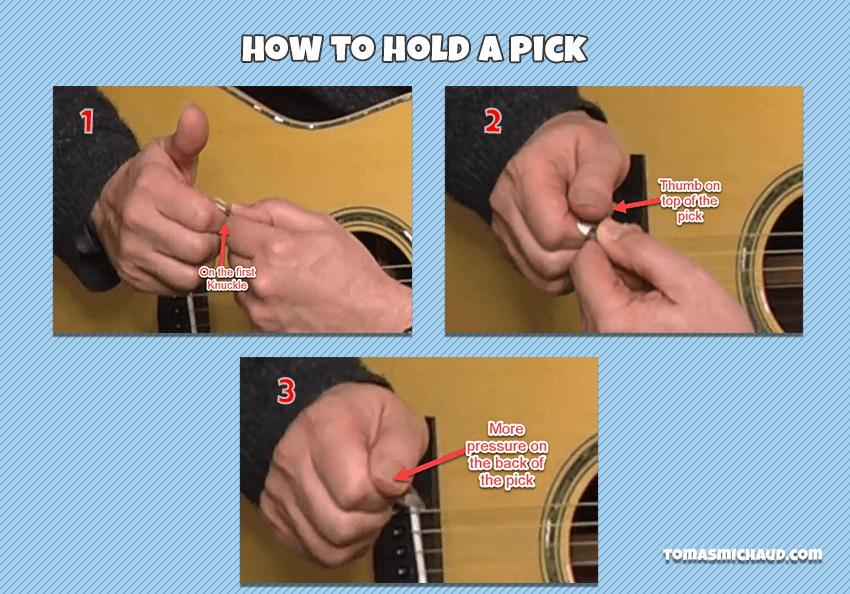
- Curl your first finger in on itself and place the pick on top of the first knuckle.
- Put your thumb over it so the tip of the pick sticks out.
- Roll your thumb back a little, so you’re pressing on the back part of the pick. The pick should still wobble a bit. That wobble helps you get a smoother strum.
If the pick keeps falling out, you probably aren’t holding the back of it firmly enough yet. That’s normal, and it gets better with practice.
Some people point the pick more, with the finger and thumb aimed toward the strings. That gives a slightly lighter sound. Try both and see which you like.
Which Pick Thickness?
I recommend a medium pick for beginners. A thin pick makes strumming a little easier, but it’s harder to play single bass notes with. A thick pick is great for melodies but harder to strum with. If you only plan to strum and aren’t worried about melodies, a thin pick works fine.
The Strumming Motion
The picking motion is mostly back and forth, like a pendulum. Hold the pick and move your hand up and down over the strings, going about the same distance on each side of the sound hole. Most of the strums you’ll learn early on use this constant down-and-up motion, so it’s worth getting comfortable with it.
Here’s a tip: turn your wrist slightly as you strum down, and slightly the other way as you come back up. The motion comes partly from your elbow and partly from your wrist, a little more from the wrist.
If your strum sounds choppy, a stiff wrist is the most likely cause. Relax it and let it move freely.
What’s Next
Practice the down-up motion with the pick in your hand until it feels familiar. You’ll get used to the feel of the pick and how it sounds on the strings.
This is lesson 6 in my beginner series. The previous lesson is How to Tune a Guitar, and next comes First Guitar Chords.
What gives you the most trouble with the pick? Let me know in the comments.
Want more lessons like this one? Try Real Guitar Success free for 14 days.
Your comment is awaiting moderation.
i picked up guitar after 25 years and im 63 yrs old.i was watching your utube video .i can play about 20 open chords clearly ,but never played barre chords . dont no if these lessons are for me but like your technique.want to learn folk songs (james taylor ,cat stevens etc>)
where would i start
thanks
paul
Hi Tomas. I’m a 70 year old left handed gal who finally decided to take lessons. I was encouraged years ago to try right handed only to be extremely frustrated, so I sold my guitar and amp. Now that it’s more convenient to find left handed guitars, I’ve decided it’s now or never to learn. I have a Fender electric and a Baby Martin acoustic.
I’m wondering if it would be better to take lessons on line, and if I could go at my own pace. I see my teacher once a week for 1/2 hour. I feel I’m wasting money because it takes me longer to learn and my vision is poor. Sometimes I have to record my exercises/songs because I can’t play in front of him. Please advise on your process. Thanks!