

Song lessons
You can play While My Guitar Gently Weeps without barre chords: a verse built on A minor with a falling bass line, and a chorus with no-barre versions of C sharp minor, F sharp minor and B minor.
This version of the Beatles song uses a descending bass line in the verse, where the bass note walks down while the chord above it stays much the same. I teach it in two sections, with a few optional licks and a second strum once you’re comfortable. You can follow along on a steel-string or a nylon-string guitar.

Download the chord diagrams and strums (PDF) to keep beside you.
Section 1: The Verse
The first half of this section stays on A minor while the bass walks down the sixth string, one fret at a time:
- Start with an A minor chord.
- Put your pinky on the sixth string at the third fret, the G bass note.
- Take the pinky off and reach your second finger over to the sixth string at the second fret.
- Finally, use your first finger on the sixth string at the first fret, and move your second finger to the second string at the first fret.
You won’t be able to hold the full A minor chord for the last two. That’s fine; play as much of it as you can, especially the second string at the first fret. You can see the shapes at 0:44 in the video.
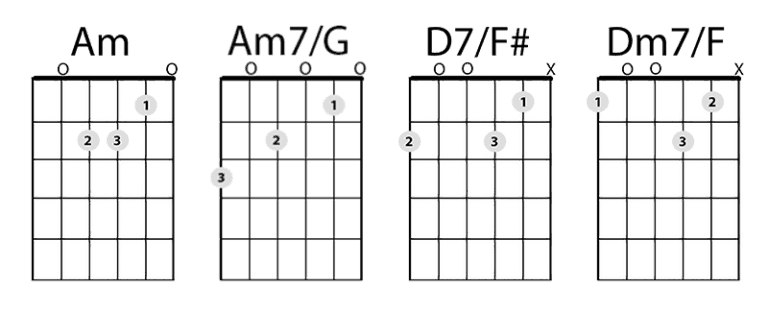
A chord name with a slash, like Am7/G, means the first chord with the second note in the bass.
The second half uses full chords: A minor, then G, then D, and E. I use the three-finger G chord with the pinky, because it’s an easier change from A minor. For the D bar, you can add your pinky on the first string at the third fret to make Dsus4, then lift it for D. That’s optional; plain D works fine. To get to E, slide your first finger down a fret and move your second and third fingers over.


The strum is down, down, down-up, down-up, counted “1, 2, 3 and 4 and.” Strum it once per chord.

Section 2: The Chorus Without Barre Chords
This section normally uses barre chords, but here are versions without them. You can switch to barre chords later, once you’re comfortable.
- A: I put my first finger across the fourth and third strings at the second fret, and my second finger beside it on the second string. Any A you know is fine.
- C sharp minor: first finger on the first string at the fourth fret, second finger on the second string at the fifth, and your third finger and pinky on the fourth and third strings at the sixth.
- F sharp minor: a partial barre. Coming from C sharp minor, lift every finger except the third and slide down two frets, so your third finger is on the fourth string at the fourth fret. Then lay your first finger across the first three strings at the second fret. If the first string is hard, barre just the second and third.
- B minor: exactly the same shape as C sharp minor, two frets lower.


Start with four strums per chord to get used to the shapes.
Optional Licks
- Play C sharp minor and F sharp minor as barre chords for a fuller sound. It’s not a big difference, so don’t worry about it.
- Slide down by half steps from C sharp minor through C minor to B minor.
- In place of the last E chord, play a little bass run up the sixth string: the open string, then the second, fourth, fifth and seventh frets.


I demonstrate these at 6:15 in the video.
A Second Strum for the Chorus
Once the song goes smoothly with the first strum, you can change to a pop-rock strum on the chorus for some variety: down, down-up, skip, up, down. It gives the chorus a more relaxed feel. It’s at 7:30 in the video.

Putting It All Together
Playing the sections back to back is its own challenge, since you’ve practiced them separately. Take it slowly, and use a metronome at a slow tempo to keep your rhythm steady. When you’re comfortable, raise the tempo no more than 5 beats per minute at a time.
When you’re ready, play along with me at 8:28.
Want more lessons like this one? Try Real Guitar Success free for 14 days.
NICE very NICE..Thank You. 1 of my favorites
You welcome rest. It’s one of my favorites too. -Tomas
Hope to get good enough to try this one…..love the melody! Thank you for all the encouragement as I am a beginner, and thank you for the demos and challenges to LEARN! Very excited going through the Beginner sessions. You are an inspiring teacher, Thomas!!!
Thanks Patricia. You’ll find that I include lessons in the Guitar Gym in the membership (RGS Academy) that support the song. In other words more detailed lessons on specific chords and techniques. The one that ties to this lesson comes out in February.
I had a lot of fun with this lesson. It taught me some new things that I can apply right away. Thanks a lot.
I’m glad you like it Shulamit. I’ve added some lessons for February in the Academy that will support this song.
A.nice arrangement .I’ll give it a try . Thank you !
Excellent lesson for a real classic Beatles song. Remembering George Harrison genius.
Many thanks Tomas
I love this song. I’m glad you enjoyed the lesson Ger. – Tomas