

Chords and strumming
Major 7 chords have a mellow, jazzy color, and they show up in every style of music, not just jazz. Here are three ways to play G major 7, from the simplest to my favorite.
A major 7 chord is the mellower cousin of the dominant 7 chord. Use one in place of a plain major chord and it softens the sound and adds a little color to the progression. G major 7 is a good one to start with, because G is such a common key on guitar.

How Gmaj7 Is Written
You’ll see this chord written a few ways: G major 7, Gmaj7 and sometimes GM7, with a capital M. GM7 can be mistaken for Gm7 (G minor 7, with a lowercase m), which is why Gmaj7 is more common. When I’m writing by hand, I often use the jazz shorthand: a small triangle after the G, like this: G△7.
Version 1: The Simplest Gmaj7
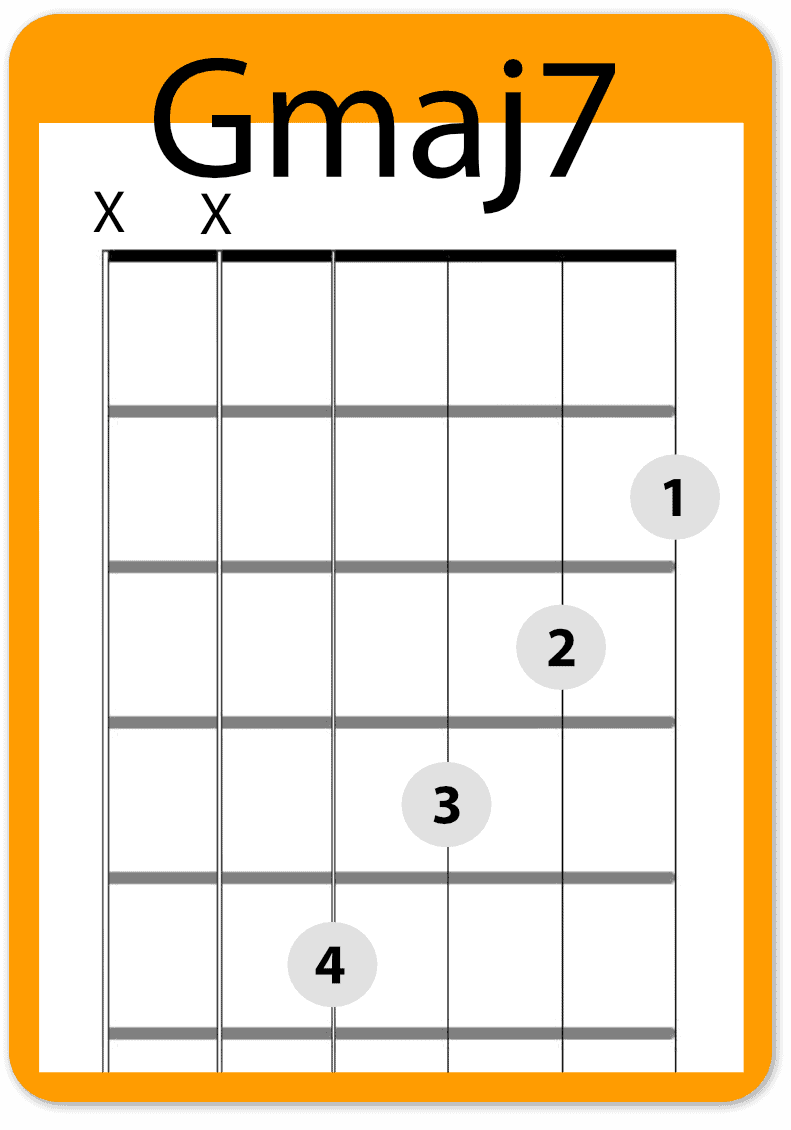
Put your first finger on the first string at the second fret. Then your second finger goes on the second string at the third fret, your third finger on the third string at the fourth fret and your pinky on the fourth string at the fifth fret.
Each finger is one string over and one fret up from the last one, so the shape is simple to remember. Play only those four strings. This is a movable shape, too: slide it to other frets and it plays other major 7 chords.
Version 2: The Jazzy Gmaj7

This is probably the most common way to play Gmaj7, especially in jazzy songs, and it’s the first version I learned. Put your first finger on the sixth string at the third fret and your second finger on the second string at the third fret. Then your third finger and pinky go on the fourth and third strings at the fourth fret.
You only play four strings here, even though I strum all six. Angle your first finger slightly so it touches the fifth string and keeps it quiet, and let your palm rest lightly on the first string so it doesn’t ring.
If you know the B minor barre chord, there’s another way to find this shape. Play B minor with the barre at the second fret, keep every finger where it is except the first, and move your first finger to the sixth string at the third fret. Now it’s a Gmaj7.
Version 3: The Full Gmaj7 (My Favorite)

I first learned this fingering from a Gipsy Kings song, and it’s the fullest-sounding version of the three. Put your second finger on the sixth string at the third fret. That’s the G in the bass.
Then make something like version 1 with your other three fingers: first finger on the first string at the second fret, third finger on the second string at the third fret and pinky on the third string at the fourth fret. The fourth string rings open. Let your second finger lean just enough to touch the fifth string and keep it quiet.
Unlike version 1, this one isn’t movable; it only works for G major 7. If you hear any buzzing, adjust your fingers slightly until each string rings clearly.
Practice It in a Progression
The best way to get comfortable with a new chord is to practice it with other chords. Try this progression, which I took from my song Moonlight Samba: Gmaj7, Em, Cadd9, D7.
Play it with all three versions and see which one you like best. You’ll probably find that each version fits a different situation, which is why it helps to know all three.
Which version is your favorite, and which one gave you the most trouble? Let me know in the comments.
Want more lessons like this one? Try Real Guitar Success free for 14 days.