

Chords and strumming
Almost every student I’ve taught has struggled with the F chord, and I did too when I started. There’s a gentler way in: start with a two-finger form, then build up one step at a time, all the way to the full barre chord if you want to go that far.
Think of it as a ladder. Each step is one rung, and you get comfortable on it before you climb to the next one.

What the F Symbol Means
“F” is short for the F major chord. It’s a major triad, made of three notes: F, A and C. When you play an F chord on guitar that uses more than three strings, you’re doubling some of those notes.
Why Learn the F Chord?
I’ve had students tell me they solve the problem by avoiding the F chord. That cuts out a lot of music you could be enjoying.
The first reason to learn it is that it’s one of the most common chords there is. The key of C is one of the most popular keys on guitar, and in the key of C, F is one of the chords you’ll use most, along with C and G. Without the F chord, you won’t be able to play most songs in the key of C.
The second reason is that learning it improves your playing overall. It strengthens your fingers, builds better technique, and gets you started on partial barre chords and full barre chords, if you choose to go all the way.
Is the F Chord Really That Hard?
Yes and no. It has a bad reputation for two reasons:
- It uses a different hand technique and a different way of thinking than the chords most people have played up to that point.
- Most people try to take one big leap to the full F chord without preparing for it.
Picture a 6-foot fence. Trying to jump straight over it doesn’t work, and a running start doesn’t help much either. Now picture walking up to the same fence with a 6-foot ladder. You put one foot on the first rung, then the second, and before long you’re stepping over the top.
The steps below are that ladder. With a little patience, you can go as far with the F chord as you want.
Six Steps to the F Chord
Take your time on the first step. Students sometimes rush through it to get ahead, but the time you spend here pays off many times over. Practice each step on its own, with other chords and in simple songs, before moving on.
Step 1: The Two-String Partial Barre
Lay your first finger across the first two strings at the first fret. This is the hardest part.
Let the first knuckle of that finger collapse and push the second knuckle up into the air, as in the photo below. Then pluck each string with your picking hand to hear how clearly it rings.

It’s tempting to make the notes sound better by pressing harder. Instead, try adjusting the angle of your hand and moving your finger closer to the fret (not on top of it). It’s a balance of the right position and just enough pressure. If you only press harder, your hand gets tired very quickly.
Step 2: Add Your Second Finger
Next, add your second finger on the third string at the second fret. That makes a three-note F chord.

Many students find that their second finger touches the second string when they add it. If that happens, keep making small adjustments until it sounds good.
Step 3: Practice Changing to Another Chord
Once you’re getting comfortable with the three-note F, practice changing between it and another chord. I usually recommend C, because it’s a common partner for F and it gives you lots of repetitions forming the F chord.
This is a good time to use the chord in simple songs and exercises, too. When you’re fairly comfortable, move on.
Step 4: The Four-String Partial Barre
Now add your third finger on the fourth string at the third fret. Most people find this a fairly small step after the three-note form. Go through the same process as in step 3 until it feels comfortable.

Step 5: Add a Barre Chord Exercise
Before you try the full barre F chord, practice at least one barre chord exercise. It helps with the F chord and with barre chords in general. The video below has three exercises; start with the first or the second.

Start including an exercise in your practice while you’re still working on the partial barre F, perhaps a few minutes each day. You can work up to all three exercises, but don’t stress over it. You can always come back to the others later.
Step 6: The Full Barre F Chord
The last step is the full barre chord. Form it, then check that every note sounds. Once you’ve done this for a while, go back through the same exercises you used for the partial barre version.

Practice Along With Me
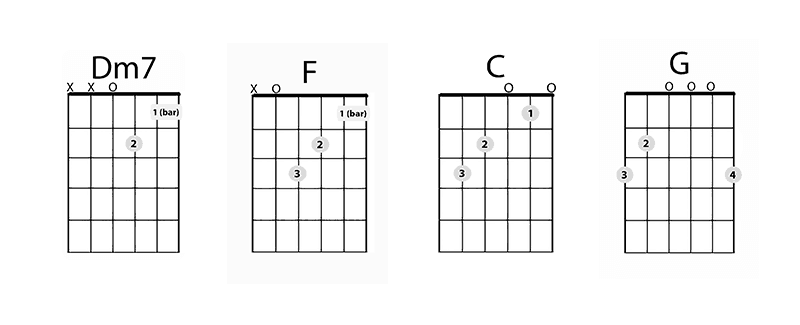
To help you practice the F chord, I made a 5-minute practice session that many students find helpful. It’s a play-along video, not a lesson: think of it as practicing with your teacher for five minutes. Practice the three-note and four-note forms on their own first, and when you’re ready, play along.
For the most benefit, play along once or twice a day for a while. Here are the chords I use in the session.

If You Run Into Problems
The two most common problems with the three-note form are:
- The second string buzzes.
- Your second finger, reaching for the third string, mutes the second string.
Almost everybody runs into these at first. In both cases, the answer is to keep making small adjustments and practice a little at a time.
It also helps to make sure your guitar’s action is adjusted properly, so the strings sit the right distance from the neck.
Try not to get discouraged. Over time your fingers get stronger, and the small adjustments add up until the chord sounds better and better.
Other Ways to Play F
I show several versions of the F chord in the video. For most people, the partial barre F is the best place to start, and the partial barre technique comes in handy for other chords too, like Em7(b5).
Don’t rule out starting with the full barre chord, though. Some people find it easier once they’ve practiced the barre itself, and it opens the door to barre chords up and down the neck sooner.
There’s also an F with four fingers and no barre at all. You’ll find it in easy F chord on guitar, no barre needed.
You’ll need all of these eventually, so none of the learning is wasted, whichever one you start with.
Final F Chord Notes
Don’t avoid songs that use the F chord. I’ve seen students get there over and over by working at it a little at a time.
Your hand may feel a little sore, especially the muscle between your thumb and first finger. It’s like working out at the gym: your muscles might be sore for a day, and after a day or two of rest you’re ready to go again. If you need a day off, take it, then come back to it.
If you’d like help deciding where your practice time will do the most good, take the free Guitar Success Checklist: a few short questions, and you get a personalized report.
What’s giving you the most trouble with the F chord? Let me know in the comments.
Want more lessons like this one? Try Real Guitar Success free for 14 days.
Thanks Tomas, I’ve added a slide show of my guitar shop at my website. Two projects underway, an Arch Top restoration and a Ramirez Flamenco 1909 replica. I practice your F chord and other lessons while waiting for glue to dry. Just click on the guitar icon at the bottom of the index page. Keep up the great work. 🙂
Mike
What a revelation! Thank you for this post.
Just did my first barre chord thank you so much
Hey Tom thanks fpr the tip, it really helped a lot. I had been strugling and trying to find a way to make it easy and your tips are awesome and simple to follow.
You’re very welcome Felix.
Tomas thank you so much. I an sixt nine years young and although I played guitar rather badly as a youth struggling with chord shapes Barr chords were a real challenge. You manner of d livery is refreshing. When I retired some eight plus years ago I elected to revisit my guitars and learn to prove. I was looking at the maxim ‘use it or loose it’. I genuinely wanted to achieve a degree of success. I purchased literally hundreds of pounds of books and DVD tutorial material. This I should add was after a fairly successful guitar course whereby the ‘teacher’ requested the newbies to tune their guitars and spent the rest of the evenings addressing his more accomplished ‘pupils’ . It was hopeless, thus my going down the online road. I have two totours in particular that I follow. One is called Griff Hamlin an American and Mike Herberts an English . They both send material on a regular basis along with selling loads of course material.
Often family commitments can impede the learning curve. I have the added angst in that I married into a very musical family. My wife, for instance played Bassoon in the National Youth Orchestra. My daughter plays grade eight piano and grade five flute. My father-n-law and brother-n-law played saxophone and clarinet for many years. My final reason for limited success is I do not take critics lightly and the last three mentioned can be inhibiting in their disquiet that I so many guitar. This is why I have never played before any of them; choosing to keep my playing private.
Keep up the great work. I look forward to revisiting your online tuition not least because you make it easy to follow.
Hi Alex,
Glad to be apart of your musical journey. Keep up the good work, and know we’re cheering you on!
– Aimee
Customer Care
Thanks Thomas. I have played guitar for 59+ years and taught for 54+ years. My students have always had problems with the F chord. So I usually have them use the F chord fingering way up the neck where the frets are closer together and then move on down to get to the first fret. Gradually over time most of them succeed in playing the F chord in the first position. The 10th position seems to be a good place to start.
That makes sense. Thanks for the tip Gordy.
– Tomas
me and my wife not long started playing guitar. and we would like to learn to play better. thank you.
Hi Wayne, if you are looking for some additional guitar help, check out my online guitar school at Real Guitar Success. https://www.realguitarsuccess.com
I have a trial membership (14 days for $1) where you and your wife can explore what I have to offer to see if it’s right for you!
Hello Tomas,
I stopped playing guitar 30 years ago, because I sold my Les Paul Custom & my Guild D-40, because my house needed repairs to be done. So now that I'm 70 years old, I purchased a new Taylor 114ce guitar on April of 2026. I've been practicing everyday, I knew most of the chords from before, but the F bar chord was problem with pointer finger across the fret, I brought a finger exerciser, and that help me out, now that I'm older. What helped me out playing the F bar chord, was playing the F minor bar chord first without middle finger, then I added the middle finger to complete the F chord.