

Chords and strumming
The bass note strum is a bass note, then a strum, twice in each measure. It’s one of the first strums to learn after the simple down-up, and it teaches you the bass note of every chord you play.
You’ll hear it in easygoing country, folk and pop, and played faster in country rock. It’s also the starting point for fancier strums like the boom-chicka.

Why Learn It
- It trains your aim. Hitting one bass note and then the whole chord teaches you to land your pick in the right place.
- It teaches you bass notes. To play the bass note, you have to know which string it’s on. That helps you learn the fretboard, and it’s a first taste of music theory.
How to Play It
Count four beats in each measure: 1, 2, 3, 4. Play the bass note of the chord on beats 1 and 3, and strum the chord on beats 2 and 4. Bass, strum, bass, strum.
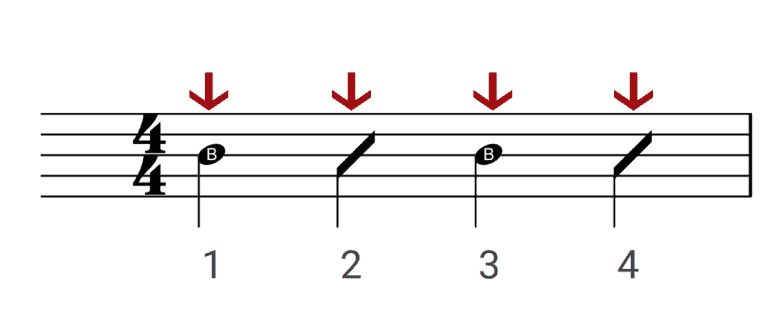
Start with a G chord. Its bass note is on the 6th string, 3rd fret. Play that note, strum, play it again, strum.
Keep to down strums for now. Once it feels steady, you can add up strums on the “and” after beats 2 and 4. Just keep the bass notes on 1 and 3.
Where the Bass Note Is
The bass note is the root of the chord, the note the chord is named after. For the four chords in the exercise below:
| Chord | Bass note |
|---|---|
| G | 6th string, 3rd fret |
| Em7 | 6th string, open |
| Cadd9 | 5th string, 3rd fret |
| D | 4th string, open |
The 6th string is the easy one to hit. Aiming for the 5th and 4th strings takes more practice, so give Cadd9 and D a little extra attention. Don’t worry if you catch another string at first. The more you do it, the more it becomes a habit.
The Exercise
First, practice the bass strum on each chord by itself. Then play one full measure (bass, strum, bass, strum) on each chord: G, Em7, Cadd9, D, and start over. Go slowly.
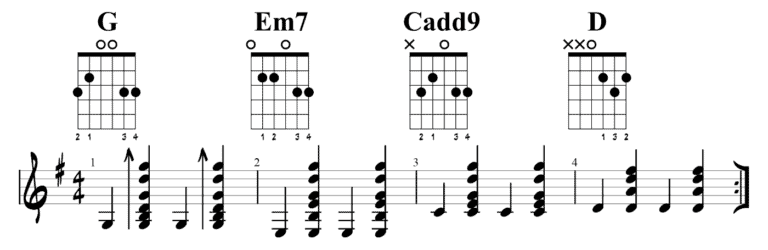
The chords move between each other with only small changes. Cadd9 is the four-finger G with the middle and index fingers moved over one string. That makes this a good progression for practicing changes at the same time.
Want more lessons like this one? Try Real Guitar Success free for 14 days.