

Chords and strumming
If you know an A chord, you’re most of the way to B flat. Move the A shape up one fret and add one finger, and you have the most practical version of this chord.
B flat is one of the most useful next-step chords for a beginner, because it opens up a lot more songs. It’s a tough one at first, but this version is very practical, and even after you learn barre chords, you’ll probably use it more than any other.

What’s in a B Flat Chord
B flat (written Bb) has three notes: B flat, the root, plus D and F. You can play it many ways on the guitar, but every version uses only those three notes, in different places on the fretboard and sometimes doubled. When I first understood that, it took some of the mystery away. If you’d like to know more about how chords are built, intervals are a good place to start.
How to Play the B Flat Chord
I teach this chord by comparing it to the A chord, which you probably know already.
- Make an A chord with your second, third and fourth fingers, side by side on the second fret of the fourth, third and second strings.
- Move all three fingers up one fret, to the third fret. That’s a half step.
- Put your first finger on the first string at the first fret.
- Strum the top four strings only.

Practice the Chord on Its Own
Now take your fingers off and place them directly on the B flat shape, without making the A chord first. Pick each string one at a time and check that it sounds clearly. Adjust your fingers if it doesn’t.
Most people don’t get it right at first, and it may sound pretty muffled. That’s how it’s supposed to be at this stage. After about a minute, take your fingers off and shake out your hand, then try again, making small adjustments each time.
- Get your fingers as close to the frets as you can without being on top of them.
- Your first finger will angle slightly on the first string. I get the best sound when I roll it a little onto its side rather than pressing straight down on the pad.
- Rest your thumb on the back of the neck.
Spend some time on the chord by itself, maybe a week or longer, before you start using it in chord changes. Your fingers may get a little sore; that’s normal.
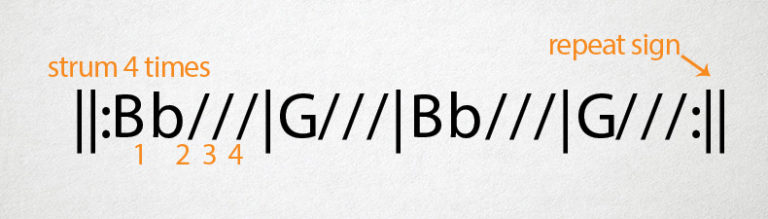
Chord Change Exercise: B Flat to G
Strum B flat four times, then G four times, and repeat. I use the G chord with the pinky, because there’s very little movement between it and B flat, but any G works. Eventually you want all your fingers landing at the same time; that just takes practice.
Want more lessons like this one? Try Real Guitar Success free for 14 days.
Thank you so much! This was very clear and helpful.
I’m trying to write music for a song about Proverbs 3:5,6
“Trust in the LORD with all your heart …”
I have chords A, Bflat, F, D.
Very basic strumming and singing the words from the Proverb with personal application.
Any suggestions for writing music?
Blessings! Happy Thanksgiving.
Hi
Love your style of teaching and already picked up a lot . I’d like to know exactly how to find your site as each time I did it was only by fluke .
Also any emails or notifications from you would be appreciated .
Thank You
Linda
Hi Linda. Just go to https://tomasmichaud.com
– Tomas
Really enjoying your BEGINNING Guitar Series . Everything is well explained and easy to follow.
I’m glad you like it David. -Tomas
How do I continue where I left off without pressing the next button to get to it? Thanks