

Guitar skills
A few shortcuts tell you the name of any note in the first 10 frets or so, and a short exercise each day trains your fingers to go there by ear.
Knowing where the notes are helps you play barre chords, learn songs and techniques, and get around the neck more easily.
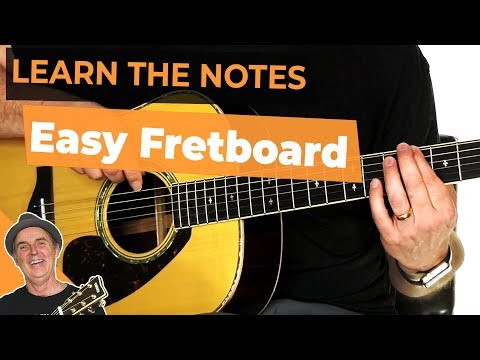
1. The Open Strings
Even players who play fairly well sometimes skip this step, so let’s go over it. The strings are numbered from the highest in pitch, so the thin high E is the 1st string and the thick low E is the 6th.
| String | Note |
|---|---|
| 6th (thickest) | Low E |
| 5th | A |
| 4th | D |
| 3rd | G |
| 2nd | B |
| 1st (thinnest) | High E |
One way to remember them, low to high: Eddie Ate Dynamite, Good Bye Eddie. Make up your own if you like. Eventually you’ll just point to a string and know it’s the G string.
2. The Musical Alphabet
The musical alphabet is A, B, C, D, E, F, G, and then it starts over. A sharp (#) is one fret higher. Every letter has a sharp except two: there’s no B sharp and no E sharp. B goes straight to C, and E goes straight to F. Don’t worry about flats for now.
So on the low E string: open is E, the 1st fret is F, the 2nd fret is F#, and the 3rd fret is G.
Start with the 6th and 5th strings. The name of a barre chord comes from the note under your first finger on one of those two strings, so a G barre chord starts on the G.
3. The Notes on the Dots

Most guitars have dots on the 3rd, 5th and 7th frets. Learn the six notes there on the two lowest strings:
| Fret | 6th string | 5th string |
|---|---|---|
| 3rd | G | C |
| 5th | A | D |
| 7th | B | E |
Read the 6th string, then the 5th, and it goes up the alphabet: G, A, B, C, D, E. From those six you can find the notes around them. One fret above G is G#, one above A is A#, and one above B is C, since there’s no B sharp.
4. Find the Octaves
An octave is the same note eight notes higher. Once you know a note on the low strings, the octave shape shows you the same note on another string.
| Starting string | Octave |
|---|---|
| 6th or 5th | Two strings over, two frets up |
| 4th or 3rd | Two strings over, three frets up |
5. The Note Exercise
Figuring out note names is useful, but what matters more is that when you hear a note, your fingers go there. My college guitar teacher gave me this exercise. I thought it looked silly and low tech, but I did it anyway, and I was surprised how soon my fingers knew where to go.
- Pick a note on the 6th string, for example the G at the 3rd fret.
- Find a G on the 5th string. It can be an octave higher. Use your ears: play, listen, and move up or down until it matches. You can work out the letters if you need to, but try to connect the sound with where your fingers go.
- When you find it, go back and forth between the two a few times.
- Do the same on each string up to the 1st.
Pick a different note each time. Stay in the first 10 to 12 frets, where you’ll do most of your playing. Four or five minutes a day is plenty.
Download the Guitar Fretboard Worksheet (PDF), with a neck diagram of every note and these steps.
Want more lessons like this one? Try Real Guitar Success free for 14 days.
These fret exercised are very useful. Thanks
Hi Frances, I’m glad you found them helpful. I still do them from time to time. – Tomas
What good is learning the names of the notes when playing lead?? I’m serious…
Hi Paul,
It’s a good question. It’s probably not the best place to spend your time now if you’re just interested in playing rock lead guitar. Probably better to spend your time on chords (so you can play with others), scale patterns and practicing soloing over background tracks. -Tomas
THANKS!!!